Back to the main Chess page


  Chess Learn to Play


Objective
One word: checkmate. If your opponent’s King would be captured on the next move, that’s called “check.” If your opponent has no way to extricate the King from that situation, that’s “checkmate,” and you’ve won.

Tie Games
When the King is not in check but there is no legal move, the game is tied in a stalemate. The game can also be considered a draw if the pieces enter a repetitive cycle of three board positions. For instance, if you move a piece, your opponent threatens, you move back to the previous position with the same piece, and then this whole pattern repeats twice more, the game may be considered a draw.

The Basic Moves
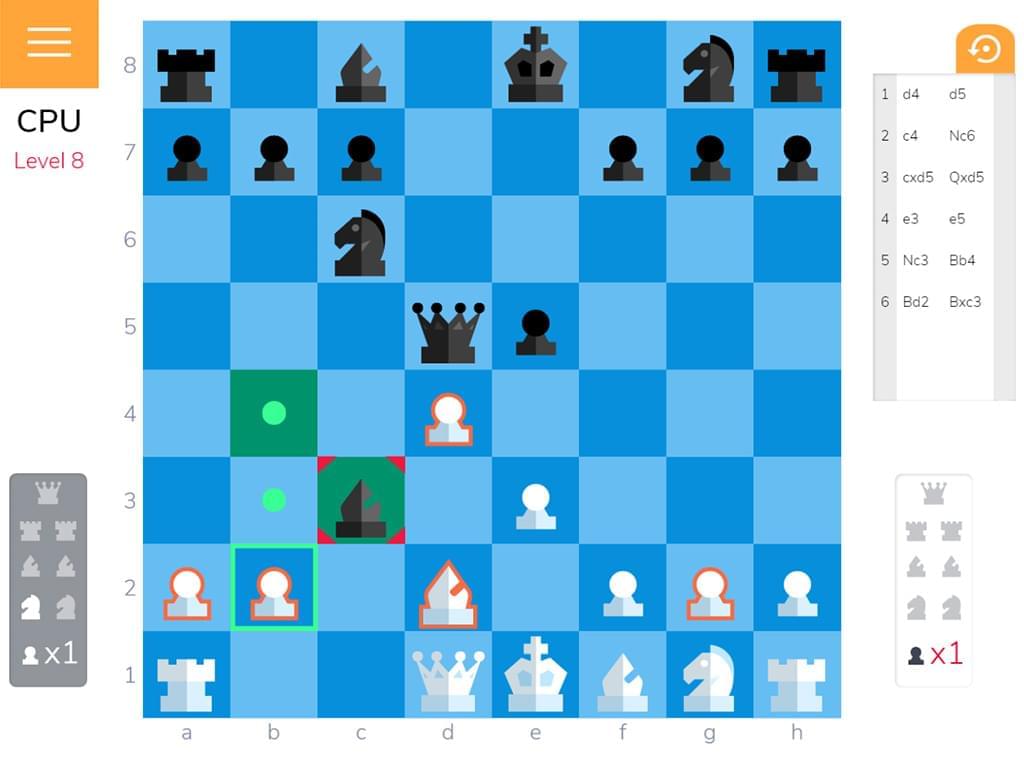
You and an opponent alternate moves. White goes first. To move a piece, click-and-drag it to the proper square. All pieces other than Pawns can move either forward or backward. Zone.com allows only legal moves, so if you try to move a piece to a square it can’t occupy, it will hop back to its last position.

King: The King can move one adjacent square in any direction – diagonal, vertical, or horizontal – unless the move would put it in check. It will capture an enemy piece occupying the square it moves into.

Queen: The Queen is the most powerful piece. She can move any distance in a straight line, diagonal, vertical, or horizontal, as long as her path is clear. The Queen cannot jump over any pieces. She captures a piece by occupying its square.

Rook: The Rook is second in power to the Queen in most positions. The Rook can move in a straight line along empty squares either vertically or horizontally but not diagonally.

Bishop: The Bishop moves diagonally any number of empty squares. Each Bishop is restricted to moving on squares of the color it started out on.

Knight: The Knight moves in L formation by going two steps vertical and one step horizontal, or one step vertical, two steps horizontal. Knights can jump over other pieces. For example, in the beginning of the game, you can move the Knight first, by jumping over the Pawn. The Knight cannot capture the pieces it jumps over, only the piece on the square where it lands.

Pawn: The Pawn normally only moves straight forward one space at a time; however, when a Pawn first moves, it can move either one or two squares straight forward. Also, a Pawn cannot capture by moving straight forward; instead, it captures one space diagonally.


Page 1 of 2

next page 


advertisement